Research Article | | Peer-Reviewed

Socio-economic Study and Technological Production of Kissangua: A Traditional Angolan Fermented Beverage

Received: 30 December 2025     Accepted: 16 January 2026     Published: 25 February 2026
Views:       Downloads:
Abstract

Kissangua is an Angolan traditional fermented beverage, generally made from corn flour, consumed throughout the country, mainly produced in the central and southern regions of Angola. It is usually consumed on cultural and festive occasions and is highly appreciated. Despite being a very popular drink, its production remains traditional and on a small scale, with the main points of sale being the street and informal markets. The objective of this study is to understand the socio-economic aspects and traditional processes involved in the production of kissangua. To achieve this objective, a survey was conducted in the cities of Kuito, Huambo, and Malanje involving 35 kissangua producers and 100 consumers, allowing for an understanding of the sensory characteristics of the beverage. The results showed that the production of this beverage is an activity almost exclusively carried out by women. It was possible to identify different technological processes to produce Kissangua, with two processes proving to be the main ones: the producers in Kuito and Huambo apply the same technology, while in Malanje a different process is used. In Huambo, the acceptance criteria for kissangua are related, among other things, to its sweet taste and the presence of coarse flour; in Kuito, they are linked to its sweet taste, the presence of coarse flour, its fermented aroma, and its acidity; while in Malanje, consumers associate its overall appreciation with its sweet taste, the presence of bran, and its coarse flour.

Published in Journal of Food and Nutrition Sciences (Volume 14, Issue 1)
DOI 10.11648/j.jfns.20261401.19
Page(s) 100-107
Creative Commons

This is an Open Access article, distributed under the terms of the Creative Commons Attribution 4.0 International License (http://creativecommons.org/licenses/by/4.0/), which permits unrestricted use, distribution and reproduction in any medium or format, provided the original work is properly cited.

Copyright

Copyright © The Author(s), 2026. Published by Science Publishing Group

Keywords

Kissangua, Corn Angolan Beverage, Socioeconomic and Technological Process

1. Introduction
Fermentation is one of the oldest methods of food preservation used by humans. This process occurs thanks to the intervention of microorganisms whose activity modifies both the organoleptic properties and the shelf life of the product. The main groups of microorganisms involved in the fermentation process are lactic acid bacteria and yeasts, which alter raw materials such as milk, meat, fish, vegetables, fruits, roots and tubers, and cereals, especially starchy foods such as cassava, millet, rice, sorghum, and corn, which are an important part of the diet in developing countries .
Traditionally fermented cereal-based beverages are widely consumed in many parts of the African continent, their consumption generally associated with beliefs, social, religious, and even dietary aspects. Like other fermented foods, these beverages are consumed for their various advantages, including desirable nutritional and sensory properties, as well as microbiological stability. This stability is associated with their low pH, the presence of ethanol, enzymes, and other metabolites that contribute to product preservation, in addition to sensory properties influenced by processing methods and the metabolic activity of the different species of microorganisms involved in the manufacture of these products and . Fermented products have been of great importance in the diet of Africans, mainly as transitional foods for young children .
The result of this process is a diversity of fermented foods such as gowé in Benin , amahewu in different countries of Sub-Saharan Africa , kenkey in Ghana .
In the scarce documents published on the subject, Kissangua, also spelled quissangua and traditionally as “ocisangwa/otchissangua”, is defined as an Angolan beverage made with simple and natural ingredients, but which does not have a manufacturing standard , traditionally fermented in pottery containers called moringues . Depending on the place of manufacture of the beverage, there is a great variability of ingredients and consequently of flavors of the final product, and it is possible to obtain varied versions from slightly alcoholic ones such as pineapple kissangua, to more alcoholic and non-alcoholic ones, and it can sometimes be called a carbonated beverage or corn beer .
Currently, kissangua is sold on the streets, in markets, and at bus terminals, in both rural and urban areas, and consumed at festive and other cultural events, mainly in the south-central provinces of Angola. This sector generates jobs, especially for young women who often had to abandon their studies. Therefore, it is necessary to conduct in-depth studies to better understand the production, marketing, and consumption processes of kissangua, which will contribute to the popularization of the product and thus strengthen the diversification of traditional fermented products in Angola.
2. Material and Methods
The geographic scope of this study encompasses the region of the cities of Huambo in Huambo province, Kuito in Bié province, and Malanje in the province of the same name, as they are considered areas of high production, sale, and consumption of kissangua in Angola. The municipality of Kuito is located between 12°23’ S and 16°56’ E; Huambo is located between 12°46’ S and 15°44’ E; and Malanje is located between 9°32’ S and 16°20’ E.
2.1. Field Survey
The survey was conducted through interviews based on a questionnaire and observation of the actors involved in the work. It comprised two main phases:
1) an exploratory phase.
2) a data collection phase.
2.1.1. Exploratory Phase
The exploratory phase identified the main areas of production and commercialization of kissangua. This preliminary survey revealed a lack of statistical data on kissangua production in Angola. Based on acquired experience, the municipalities of Kuito-Bié, Huambo-Huambo, and Malanje-Malanje were identified as areas of high production, sale, and consumption of this beverage, and were therefore selected for further investigation due to their strategic location.
2.1.2. Data Collection Phase
Consumption Survey
Thirty-five (35) people were interviewed in each of the three cities. The research was carried out at the production sites, particularly in the informal markets of the cities of Kuito, Huambo and Malanje. The questionnaire administered to producers provided information on consumption frequency, preferences, and possible reasons for consumption; it consisted of 30 questions, 4 of which were open-ended.
Survey on Kissangua Preparation Technologies
This survey aimed to understand the different stages of the kissangua production process, the various types of raw materials used and to identify risk practices associated with this production. It was conducted in two phases. First, a questionnaire was directed to 35 producers and sellers in Kuito, Huambo and Malanje. Then, 7 producers were selected and observed based on the production technology applied, to validate the manufacturing process and generate with this information the manufacturing diagrams used in each of the areas studied.
2.2. Sensory Analysis
The kissangua produced and marketed by the monitored producers was subjected to a sensory analysis by a panel of 100 tasters who are native consumers of the product, to describe the sensory attributes of the kissangua.
2.3. Ethical Principles
All those involved in the study, producers, sellers and members of the tasting panel, signed an informed consent form.
2.4. Statistical Analysis
The data collected during the surveys were processed using Google Forms. The statistical analysis of the data was performed based on the analysis of variance (ANOVA) using the Statistica 10 software (StatSoft, Tulsa, OK). To determine homogeneous groups, the Tukey test was performed at 95%. Principal Component Analysis (PCA) was performed using XLSTAT software (V 7.0; Addinsoft, Paris, France).
3. Results
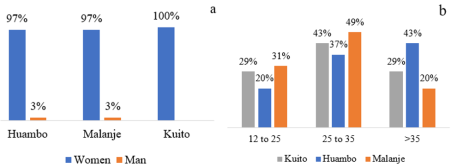
Figure 1 shows the distribution of respondents by sex and age, where in the different cities the occupation is mostly carried out by women between 97 and 100%, aged between 25 and 35 years in the cities of Kuito and Malanje, while in the city of Huambo 43% of respondents were over 35 years old.
Figure 1. Distribution of respondents by sex (a) and age (b).
Different studies have shown that the activity of producing and selling fermented products in a traditional way is mainly practiced by women, similar to the study done on gowé, where it was observed that 83.87% of producers and sellers are women aged between 15 and 25 years as weel by in different fermented products. Products like khon are produced mostly by women, accounting for 95%, and ranging in age from 15 to 50 years old .
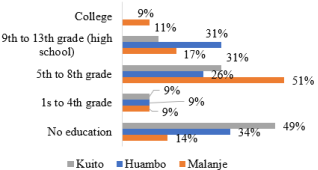
Figure 2 shows the education level of the participants, where it was observed that 51% of respondents from the city of Malanje had an education level between 5th and 8th grade. In Kuito and Huambo, the largest group of respondents had no schooling or were illiterate, 49% and 34%, respectively. Regarding respondents who completed high school, it was observed that respondents from Huambo had a higher number, followed by respondents from Kuito and Malanje with 31%, 17%, and 11%, respectively. In Malanje, 9% of respondents stated that they had completed higher education.
Figure 2. Distribution of producers and sellers according to education level.
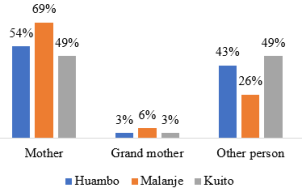
Bokossa et al., (2013) observed in their study that a large part of the people involved in this type of activity have a very low level of education, with primary education often being the highest level these people reach. A similar trend was reported by , although the picture may be reversed in large urban centers such as Abomey-Calavi where 76% of merchants sell Kon, a traditional fermented product.
Figure 3. Distribution of producers and sellers according to the source of knowledge acquisition.
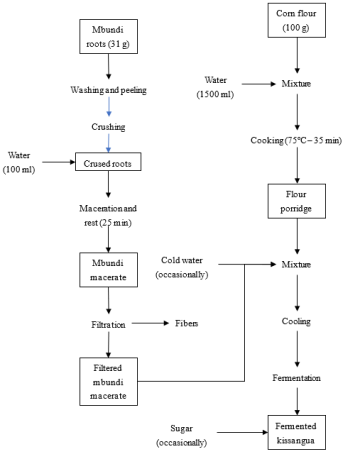
It was possible to understand according to Figure 4 and Figure 5 that the production stages and raw materials used to make kissangua, and thus, to create diagrams of the traditional production of kissangua. The diagrams created from the information collected in the different cities show a great deal of similarity. The first similarity concerns the type of raw material used; in this study, we observed that all three cities use yellow corn flour as the raw material for kissangua production. The second similarity concerns the different processing stages, which are identical, varying only in the cooking, fermentation, and use of different roots. That is, for Huambo and Kuito, the root used is mbundi, and in some cases, coarse flour may be added; however, for the city of Malanje, the root added is mucundo.
Comparing the results obtained in this study with the results achieved in the research developed on gowé in Benni (Cotonou and Abamey-Cabavi), the results found allowed us to understand different production technologies, with the raw material varying depending on the region, where corn, sorghum, or even a mixture of the two cereal species can be used, and in many cases these cereals are subjected to malting (Adinsi et al., 2015).
Table 1. Comparison of technological parameters between different locations.

Kuito

Huambo

Malanje

Cooking time (min)

40,000b

30,714b

74,143a

Fermentation time (h)

10,143b

9,343b

42,314a

Preservation life (days)

2,09b

2,17b

3,23a

As indicated in Table 1, the data obtained showed that each of the locations presents a different production technology for kissangua, when comparing the cooking, fermentation, and preservation times of the product. In general, the technology used in Malanje presented higher values and a significant difference when compared to the processes currently used in Kuito and Huambo cities, which did not show significant differences in the parameters studied.
A. R. Zinsou et al. showed that the procedures traditionally used, mainly the different unit operations involved in the production process, directly influence the different technological parameters of products such as Khon . presented the same behavior when comparing gowé produced from sorghum with that produced from corn. Similarly, identified the same trend when comparing gowé production in different regions.
It is important to note that although the kissangua manufacturing diagrams illustrate the most widely accepted processes in each local city studied, there are still other variants of kissangua produced in these cities, some of which are made using corn flour with the addition of another vegetable such as sweet potato or pineapple peel. In the city of Kuito, in Malanje, corn straw is added as an ingredient in kissangua.
Regarding the granulometry of the flour, 59.05% of respondents prefer to use coarse flour to produce kissangua, highlighting the particularity observed in the city of Huambo, where 20% of respondents prefer to use coarse flour to produce kissangua.
Figure 4. Diagram of traditional kissangua manufacturing in Kuito and Huambo.
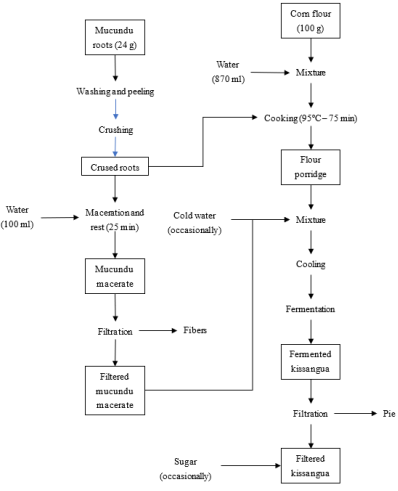
Figure 5. Technological Diagram of traditional kissangua production in Malanje.
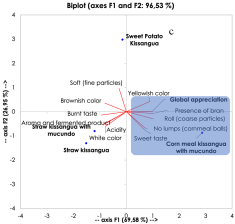
Table 2. Production cost and selling price and profit per liter of kissangua.

Kuito

Huambo

Malanje

Production cost (AOA.L-1)

10,11b

10,09b

281,67a

Selling price (AOA.L-1)

101,14b

100,86b

202,86a

Profit (AOA.L-1)

125,30b

232,86a

159,05b

Production costs are presented in Table 2, it was observed that the city of Malanje presented the highest values for production cost and sales price, showing a significant difference compared to the other cities, and was the location with the lowest profits (159.05 AOA.L-1). From a statistical point of view, no significant difference was found between the cost of production and the sales price in the cities of Huambo and Kuito; however, the profits obtained in the city of Huambo (232.86 AOA.L-1) showed significant differences when compared to the other cities.
Kissangua in the different cities was presented as a beverage consumed at different times of the year, with greater prominence during the hot season, with 72.38% of respondents indicating this period as the time of greatest demand. Consumer preference for products of this nature during the hot season is not exclusive to kissangua; Adinsi et al., (2015) and Bokossa et al., (2013) described similar behavior when conducting a socio-economic study of gowé in different cities in Benin.
It was also found that the beverage was widely available in all provinces, although it was observed that in the province of Malanje the number of respondents was lower (25 out of 35 respondents) compared to the cities of Huambo and Kuito with 85.7% and 74.3% respectively. There was a strong preference for adding sugar to the beverage (98.1%), when compared to the number of respondents who prefer to consume kissangua in its natural form, thus showing that the majority prefer a sweet kissangua (83.67%) to a sour kissangua (13.33%).
Looking at global trends aimed at the industrialization of food products such as traditional beverages, based on demand, initiatives aimed at the industrialization of kissangua are beginning to emerge. However, different actions aimed at understanding the behavior of consumers of these products cannot be disregarded.
The analysis of consumer behavior related to the mass production initiative of kissangua led to questioning respondents about three aspects. The first was to understand the issue of promoting this product among traditional producers and whether they had ever heard of canned kissangua; 67.62% stated they had never heard of it, compared to 31.43% who answered “yes”.
We sought to find out from this same group whether they had bought canned kissangua, and 84% of all respondents said no. Of those who had eventually bought and consumed the product, they highlighted processing flaws that ranged from the lack of addition of certain ingredients such as mbundi (in Huambo and Kuito) and mucundu (in Malanje), corresponding to 12.38%, another group stated that the product did not go through the effective fermentation process so that it could present the sensory characteristics of the natural product (insufficient fermentation), and a small group indicated the lack of sugar in the product as one of the rejection criteria.
Notwithstanding the responses obtained from the two previous questions, 56.19% of respondents showed intentions to repurchase canned kissangua if it underwent the adjustments indicated by consumers.
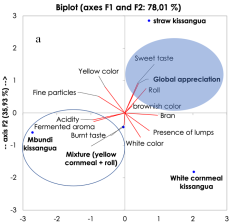
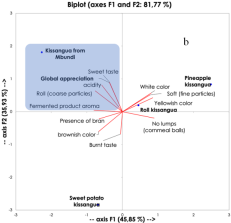
Figure 6 shows the overall appreciation of kissangua by consumers in the cities of Huambo, Kuito, and Malanje. Through Principal Component Analysis, it was possible to establish the relationship between the different sensory attributes of the beverage and consumer preference. Consumer acceptance of the beverage was related to the following sensory attributes: yellow color, fermented aroma, acidic taste, sweet taste, but with specificities for each city studied. For the cities of Huambo and Kuito, in addition to the attributes mentioned above, preference was also linked to the presence of coarse particles and the flavor of mbundi root, and for Malanje, preference was linked to the flavor of mucundu root and the absence of coarse particles.
Zinsou et al., (2022), in similar studies on fermented corn-based products called khon, found that product acceptance is associated with color, acidity, fermented flavor, and other attributes that consumers can associate with their senses. According to the study conducted by on gowé produced solely from sorghum, its acceptance is closely linked to attributes such as brown color, sweet and sour taste, fermented and cereal odor. On the other hand, gowé produced from corn is sensorially characterized by its acidic taste, presence of bran, fermented odor, and color.
Figure 6. Principal Component Analysis of consumer appreciation a) - Huambo, b) - Kuito c) – Malanje.

4. Conclusion
The results of this study showed that there is a production technology for kissangua used in the cities of Huambo and Kuito, and another in Malanje. It was also observed that kissangua is appreciated by consumers for several reasons, notably its sweet taste and the presence of roots, namely mbundi (Huambo and Kuito) and mucundu (Malanje). Although considerable resistance was observed regarding the consumption of canned kissangua, there is, on the other hand, a group of people interested in consuming it, provided that the concerns raised by consumers are addressed.
Abbreviations

ANOVA

Analysis of Variance

AOA

Angolan Kwanza

PCA

Principal Components Analysis

PDCT

Science and Techonology Development Project

Acknowledgments
We extend our thanks to the Science and Technology Development Project (PDCT) for the funding provided for this work. We also thank all manufacturers and participants in the surveys and sensory analysis sessions in the cities of Huambo, Kuito, and Malanje. We further thank students Emanuel Brage, Paula Fragoso, and Mário Bumba for their time dedicated to the project and the completion of the surveys.
Author Contributions
Isabel Balanga Pedro: Investigation, Data curation, Writing – original draft
Emanuel Eucídio Lopes Brage: Investigation, Writing – review & editing
Bettencourt de Jesus Coxe Munanga: Conceptualization, Funding acquisition, Investigation, Resources, Supervision, Validation, Writing – review & editing
Funding
This work is supported by the Science and Technology Development Project (PDCT) of the Ministry of Higher Education, Science, Technology and Innovation of Angola, through (Call for Proposals Nº. 1).
Data Availability Statement
The data supporting the outcome of this research work has been reported in this manuscript.
Conflicts of Interest
The authors declare no conflicts of interest.
References
[1] B. Munanga, G. Loiseau, J. Grabulos, and C. Mestres, “Modeling Lactic Fermentation of Gowé Using Lactobacillus Starter Culture”, Microorganisms, v. 4, n. 4, p. 44, 2016,
[2] A. T. Oyeyinka, M. Siwela, and K. Pillay, “A mini review of the physicochemical properties of amahewu, a Southern African traditional fermented cereal grain beverage”, LWT, v. 151, p. 112159, 2021,
[3] O. C. Aworh, “African traditional foods and sustainable food security”, Food Control, n. 145, p. 109393, 2022, doi:
[4] Y. I. Bokossa, C. K. C. Tchekessi, J. Banon, C. Agbangla, K. Adeoti, and P. Dossou-Yovo, “Etude socio-economique de production d’une pate traditionnelle fermentee" gowe" fabriquee a base de maïs au Benin”, J. Rech. Sci. Univ. Lomé (Togo), v. 15, n. 3, p. 53–63, 2013.
[5] L. Adinsi, N. H. Akissoé, G. Dalodé-Vieira, V. B. Anihouvi, G. Fliedel, C. Mestres, J. D Hounhouigan, “Sensory evaluation and consumer acceptability of a beverage made from malted and fermented cereal: case of gowe from Benin”, Food Sci Nutr, v. 3, n. 1, p. 1–9, 2015,
[6] C. Mestres, B. de J. C. Munanga, J. Grabulos, and G. Loiseau, “Modeling mixed fermentation of gowé using selected Lactobacillus plantarum and Pichia kluyveri strains”, Food microbiology, v. 84, p. 103242, 2019,
[7] O, Zannou, D. J. Agossou, Y. Miassi, O. B. Agani, M. D. Aisso, I. B. Chabi, Y. E. Kpoclou, P. Azokpota, I. Koca, “Traditional fermented foods and beverages: Indigenous practices of food processing in Benin Republic”, International Journal of Gastronomy and Food Science, v. 27, p. 100450, 2022,
[8] N. T. Annan, L. Poll, W. A. Plahar, and M. Jakobsen, “Aroma characteristics of spontaneously fermented Ghanaian maize dough for kenkey.”, Eur Food Res Technol, v. 217, n. 1, p. 53–60, 2003,
[9] G. Patissa, “Oratura: Breve nota sobre o sentido etimológico da bebida ‘ocisangwa’ (ensaio de Gociante Patissa no Jornal Cultura, edição No 26, de 18 a 31 de Março de 2013) Ombembwa Angola (Umbundu)”. Accessed on: November 28, 2025. Available in:
[10] J. I. R. Barros, “A Olaria na Província de Benguela: Tradição, Género e Território”, Mestrado, Universidade Aberta, Lisboa, 2019. Available in:
[11] A. P. Carvalho, “Bebidas do povo Umbundo (Angola): Quissângua e Quimbombo : Drinks of the Umbundo people (Angola): Quissângua and Quimbombo / Bebidas del pueblo Umbundo (Angola): Quissângua y Quimbombo”, Revista Angolana de Ciências, v. 7, n. 1, Art. n. 1, jan. 2025, Accessed on: July 2, 2025 Available in:
[12] C. C. Tchekessi, O. I. Choucounou, D. R. Matha, G. J. Gandeho, S. P. Sachi, S. J. Banon, T. R. Bleoussi, A. Djogbe, T. K. Assogba, P. I. B. Yaou “Technological and socio-economic study of akandji, a neglected traditional foodstuff made from corn (Zea mays L.) in Benin”, International Journal of Biological and Chemical Sciences, v. 15, n. 4, p. 1629–1647, 2021.
[13] R. Karimou, H. Sina, E. A. Agossou, B. Boya, S. A. Assogba, A. Socohou, J. A. Semassa, E. S. Attakpa, F. Baba-Moussa, A. “Typology of Fermented Porridges and Socio-demographic Characteristics of Respondents in the Northern Part of Benin”, Asian Food Science Journal, v. 21, n. 12, p. 1–12, 2022,
[14] A. R. Zinsou, A. M. Seid, M. Mazou, J. A. Djossou, N. Chabi, and F. P. Tchobo, “Socio-Economic Evaluation and Technological Production of Kom Fermented Corn Dough”, Journal of Food and Nutrition Sciences, v. 10, n. 6, p. 185–192, 2022,
[15] L. Adinsi, G, Vieira-Dalode, N. H. Akissoe, V. Anihouvi, C. Mestres, A. Jacobs, N. Dlamini, D. Pallet, D. J. Hounhouigan, “Processing and quality attributes of gowé: a malted and fermented cereal-based beverage from Benin”, Food Chain, v. 4, n. 2, p. 171–183, 2014, Accessed on: February 1th, 2016. Available in:
Cite This Article
  • APA Style

    Pedro, I. B., Brage, E. E. L., Munanga, B. D. J. C. (2026). Socio-economic Study and Technological Production of Kissangua: A Traditional Angolan Fermented Beverage. Journal of Food and Nutrition Sciences, 14(1), 100-107. https://doi.org/10.11648/j.jfns.20261401.19

    Copy | Download

    ACS Style

    Pedro, I. B.; Brage, E. E. L.; Munanga, B. D. J. C. Socio-economic Study and Technological Production of Kissangua: A Traditional Angolan Fermented Beverage. J. Food Nutr. Sci. 2026, 14(1), 100-107. doi: 10.11648/j.jfns.20261401.19

    Copy | Download

    AMA Style

    Pedro IB, Brage EEL, Munanga BDJC. Socio-economic Study and Technological Production of Kissangua: A Traditional Angolan Fermented Beverage. J Food Nutr Sci. 2026;14(1):100-107. doi: 10.11648/j.jfns.20261401.19

    Copy | Download

  • @article{10.11648/j.jfns.20261401.19,
      author = {Isabel Balanga Pedro and Emanuel Eucídio Lopes Brage and Bettencourt de Jesus Coxe Munanga},
      title = {Socio-economic Study and Technological Production of Kissangua: A Traditional Angolan Fermented Beverage},
      journal = {Journal of Food and Nutrition Sciences},
      volume = {14},
      number = {1},
      pages = {100-107},
      doi = {10.11648/j.jfns.20261401.19},
      url = {https://doi.org/10.11648/j.jfns.20261401.19},
      eprint = {https://article.sciencepublishinggroup.com/pdf/10.11648.j.jfns.20261401.19},
      abstract = {Kissangua is an Angolan traditional fermented beverage, generally made from corn flour, consumed throughout the country, mainly produced in the central and southern regions of Angola. It is usually consumed on cultural and festive occasions and is highly appreciated. Despite being a very popular drink, its production remains traditional and on a small scale, with the main points of sale being the street and informal markets. The objective of this study is to understand the socio-economic aspects and traditional processes involved in the production of kissangua. To achieve this objective, a survey was conducted in the cities of Kuito, Huambo, and Malanje involving 35 kissangua producers and 100 consumers, allowing for an understanding of the sensory characteristics of the beverage. The results showed that the production of this beverage is an activity almost exclusively carried out by women. It was possible to identify different technological processes to produce Kissangua, with two processes proving to be the main ones: the producers in Kuito and Huambo apply the same technology, while in Malanje a different process is used. In Huambo, the acceptance criteria for kissangua are related, among other things, to its sweet taste and the presence of coarse flour; in Kuito, they are linked to its sweet taste, the presence of coarse flour, its fermented aroma, and its acidity; while in Malanje, consumers associate its overall appreciation with its sweet taste, the presence of bran, and its coarse flour.},
     year = {2026}
    }
    

    Copy | Download

  • TY  - JOUR
    T1  - Socio-economic Study and Technological Production of Kissangua: A Traditional Angolan Fermented Beverage
    AU  - Isabel Balanga Pedro
    AU  - Emanuel Eucídio Lopes Brage
    AU  - Bettencourt de Jesus Coxe Munanga
    Y1  - 2026/02/25
    PY  - 2026
    N1  - https://doi.org/10.11648/j.jfns.20261401.19
    DO  - 10.11648/j.jfns.20261401.19
    T2  - Journal of Food and Nutrition Sciences
    JF  - Journal of Food and Nutrition Sciences
    JO  - Journal of Food and Nutrition Sciences
    SP  - 100
    EP  - 107
    PB  - Science Publishing Group
    SN  - 2330-7293
    UR  - https://doi.org/10.11648/j.jfns.20261401.19
    AB  - Kissangua is an Angolan traditional fermented beverage, generally made from corn flour, consumed throughout the country, mainly produced in the central and southern regions of Angola. It is usually consumed on cultural and festive occasions and is highly appreciated. Despite being a very popular drink, its production remains traditional and on a small scale, with the main points of sale being the street and informal markets. The objective of this study is to understand the socio-economic aspects and traditional processes involved in the production of kissangua. To achieve this objective, a survey was conducted in the cities of Kuito, Huambo, and Malanje involving 35 kissangua producers and 100 consumers, allowing for an understanding of the sensory characteristics of the beverage. The results showed that the production of this beverage is an activity almost exclusively carried out by women. It was possible to identify different technological processes to produce Kissangua, with two processes proving to be the main ones: the producers in Kuito and Huambo apply the same technology, while in Malanje a different process is used. In Huambo, the acceptance criteria for kissangua are related, among other things, to its sweet taste and the presence of coarse flour; in Kuito, they are linked to its sweet taste, the presence of coarse flour, its fermented aroma, and its acidity; while in Malanje, consumers associate its overall appreciation with its sweet taste, the presence of bran, and its coarse flour.
    VL  - 14
    IS  - 1
    ER  - 

    Copy | Download

Author Information
  • Department of Food Science, Rainha Njinga a Mbande University, Malanje, Angola

  • Department of Food Science, Rainha Njinga a Mbande University, Malanje, Angola

  • Department of Food Science, Rainha Njinga a Mbande University, Malanje, Angola;Department of Process Engineering, Rainha Njinga a Mbande University, Malanje, Angola;Department of Biological Sciences, Rainha Njinga a Mbande University, Malanje, Angola

    Biography: Bettencourt de Jesus Coxe Munanga is a professor in the Departments of Food Science, Process Engineering, and Biological Sciences at Rainha Njinga a Mbande University. He completed his PhD in Biotechnology and Microbiology at the University of Montpellier and the Institut Agro Montpellier-France in 2017, and his master’s degree in nutrition and Valorization of Agro-Resources at the same institutions in 2012. In recent years, he has participated in several collaborative research projects. Currently, he is a member of the Editorial Board of the Angolan Journal of Sciences (RAC) and hi is member of the Angolan Academy of Sciences (AAC). He has been invited as a keynote speaker, technical committee member, and scientific committee member at international conferences.